Olam.i Interviews: Rachel - Herbalist and Holistic Healer Based In London
December 19, 2025
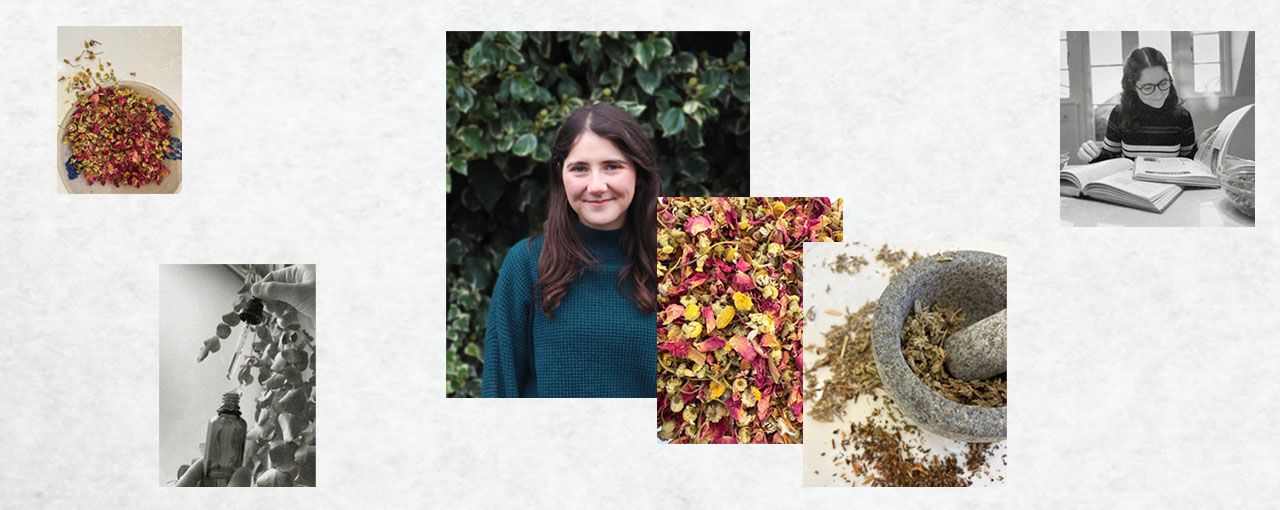
Rachel is a holistic healer who works as a trained herbalist, naturopath, Reiki healer, intuitive spiritual practitioner, as well as currently training to be a cognitive hypnotherapist. On top of this, Rachel is also psychically in-tune, and often weaves spirituality and readings into her work.
Being raised in an openly intuitive household, with her mum being a cognitive hypnotherapist too, Rachel and her sisters grew up reading each others’ cards when they faced worries during their childhood. This knowledge gained from her upbringing, alongside her professional training ties in her offerings holistically, and allows for her to practice intuitively and sensitively with each of her clients.
The Interview:
Olam.i:
"How would you describe herbalism / your practice to someone who’s never explored these modalities?"
Rachel:
“Herbalism is an ancient practice. It’s a continuation of the practices that our grandparents, and great grandparents, and ancestors did, and is now tied into this modern day setting. Herbal medicine is essentially home remedies, and the practices that have been passed down through the generations. It’s a holistic practice where we seek out the root cause rather than the symptom, and using solely herbs and plants to do that. We look at the whole person rather than the part that’s suffering, and that’s a really big part too. We don’t look at just one part. If someone comes in with a gastric issue, we’re going to look at their hormones, skin, and all the parts that make up the person.”
“And in terms of holistic healing, that is my connection between mind-body-spirit to heal myself and then heal the client. It’s to access that deeper structure of what’s going on underneath. It incorporates everything. Whilst I can also aim to heal issues through herbal medicine, I can also do so energetically through reiki, or through hypnotherapy (very soon) too.”
___________________
Olam.i:
"What first drew you to herbalism and your practice, and what has your path looked like on this journey so far?"
Rachel:
“I had a lot of health issues growing up, and I was always taking the medicines that everyone told me to, and nothing ever worked. Like, never got better. Not even marginally. And then I went to see a nutritionist when I was 19, and she changed my life. It was the first time ever that I felt better, and that I felt energetic, and my symptoms were gone. And I could finally see a life in which I didn’t have my problem, instead of a life where I was just on medication forever. And that was what initially drew me to herbal medicine. And then from there is where I then realised that there was a space to share and practice what I had grown up with beyond just my inner circle, because I realised that there was just so much more to healing then the physical side of it.”
“I then graduated from my degree, which was honestly a different me, and then covid hit. And thank God! It slowed everything down for me and finally gave me a chance to realise that I don’t need to do what everyone else is doing. And I then started my training when I was 21.”
___________________
OLAM.I:
"What can someone expect during their first session with you?"
RACHEL:
“A first initial consultation depends on what is it you’re coming to me for. If you’re coming specifically for herbs, or herbal medicine, that will require a lot of questions. It’s a big case taking. We will cover why you’re there and what’s going on. This is then followed by what I like to call a ‘top-to-tail’, where I ask you about everything going on in your body - your reproductive system, your digestive system, your nervous system - to get a full picture of you as you are. Herbalism is a holistic practice, so we really want to look at the body as a whole. We never look at anything as just one part alone. We then talk about how you want to take your herbs and what works for you, and you will walk out with a herbal prescription, a simple diet plan if you want one, and some lifestyle advice.”
“Reiki, on the other hand is very different. Here, we are not in the business of diagnoses. You can come in and tell me what you need, or you can just come and say ‘I need reiki’, and both work. Because the idea is not that I’m doing anything, I am a channel for energy, and the energy will go wherever it needs to go for your highest good. So, in a first consultation in Reiki, we can talk, we can not talk, I’m entirely led by the client. Just as long as we leave time for the Reiki itself. And then sometimes I get people coming to me for a holistic session where we do both, depending on what the person needs. It will be a real conversation between the two of us, working together to figure out what’s best for them.”
___________________
OLAM.I:
"How do you choose the right plants for a person? What guides that decision?"
RACHEL:
“The thing with herbal medicine is that we have a world of plants, right. And there’s so many plants to choose from which may do similar things, and we also know that individual plants do so many things. Like one plant could be good for digestion, or skin, or thyroid, or what have you. So I whistle it down in a couple of ways. I like to use local herbs, because if we grow up around a certain thing, or live around a certain thing, I believe that there’s an energetic connection there. And plants have energies too. And what I have learnt is to match the energy of the plant to the energy of the person. So if a client is a very hot person, I would suggest a plant with a cold energy. Or I try to match the emotional needs of a client to the emotional properties of the plant. For example, rose has a really big affinity with the heart, and is also a great herb for women. Rose can treat hormonal issues but it can also be used during a heartbreak. And then aside from the energy and location of the plants, it honestly comes down to intuition. As much as we do work scientifically, the science will only get you so far, and then the rest is down to intuition.”
“I’ve also got to base what I choose based on how someone wants to take the plant. I will always ask someone’s preference. If someone would rather have it as a tea than a tincture, then that will also affect the plants I choose. Some work better in different forms.”
___________________
Olam.i:
"How do herbs support the nervous system in a world that asks us to move so quickly?"
Rachel:
“Herbs are magical. Herbs calm the nervous system through a range of mechanisms working to promote GABA, and serotonin, and reduce cortisol levels, and all of that stuff. There is also an energetic dimension to herbs and that allows them to calm us down. Sometimes just the act of taking herbs can itself help to calm the nervous system. When I prescribe someone herbs for anxiety or sleep, I generally prescribe them in tea form. This is because I find that the very act of someone going about to brew themselves a tea and then sitting down to drink it is in itself is relaxing, and helps you to stop for even just a moment. They do also work best when the person is prepared to do other work to help to calm themselves."
"Things like lifestyle changes and meditation alongside the herbs is probably the most effective thing. The herbs are also a great way to get your nervous system down to where you can do that extra level of work. So if you find it hard to meditate, maybe herbs can help your mind slow down a bit, so that you can sit down and help yourself get to that extra state of calm."
___________________
Olam.i:
"How do the seasons influence the way you practise, both professionally and personally?"
Rachel:
“I love living with the season, and is something that I give workshops on. I think in terms of my herbal work it doesn’t come in too much into what I prescribe. If you’re a herbalist who works with fresh plants then the season will affect that. But I use dried plants and use what’s available to me. But it does affect the other elements of the treatment plan. So if its winter time, there needs to be a focus nutritionally on what’s growing at that time, such as root vegetables, and on having warming foods like soups, stews and broths. I do think that things grow at a certain time because that’s what your body needs at that time. That’s why different things grow in different countries at different times. Your body is very responsive to the seasons around you. It affects your circadian rhythm, your sleep, you energy levels, and so many other things, so supporting that with foods is so important. In hot climates you aren’t going to find those dense nourishing carbs growing because that’s not what’s needed. "
“In the more energetics works, each of the seasons gives us new opportunity. Winter is a time for going inwards physically and emotionally. It’s a great time for reflection. At the end of the year before New Year, you reflect on what you are grateful for. I think that’s very interlinked with winter as a season. Summer, when you’re more energetic and out more and doing more, that’s naturally because it’s a time to be outward. It’s not the appropriate time seasonally for reflection. Each season really does bring opportunity for something new emotionally and energetically as well.”
“Also within the female body, we see our cycle as seasons. It’s the same thing. Your summer in your cycle is the same as the outward summer season - you get more energy. That’s when you should be putting more focus onto your energy and exercise and your projects that you’ve really been wanting to do. And when you’re in your winter of your cycle, that’s when you give yourself that space and understanding. You know what your body can handle and that’s okay. It’s about understanding your rhythms.”
___________________
Olam.i:
"Has being a herbalist / holistic practitioner changed how you listen to your own body?"
Rachel:
"100%. I do feel like I understand my body more. When I get aches, pains, I’m like ‘Okayyy! Have I done something physical, or is there something going on emotionally?’ When I go see my osteopath, I know what the cause is now which is funny. But I really do have a better understanding of myself and my body in that way. And also I think I give my body a lot more space than I ever did before. I was giving a workshop on immunity the other day, and one of the big things we say about immunity is that when you get a big immune response, we don’t try and immediately get rid of it. That’s the body doing what its supposed to do instead of trying to get rid of a symptom of pain with painkillers or anti-inflammatory. We try and help the body do what it’s trying to do naturally rather than try to ease something faster. That kind of understanding is something that I subconsciously have interweaved into my own life. If I start to get a bit of a sore throat and I feel like a cold is coming on, I don’t panic and take a painkiller or try to get rid of it. I’m aware that my body is trying to protect me. I’m getting a sore throat because my body is not letting the cold get past my tonsils and my adenoids. I thank my body for trying to protect me. I feel more in-tune with my body in that way. I know why my body is doing what it is, because 9 times out of 10, it’s working in my favour.”
___________________
Olam.i:
"What’s one small change most people could make that would have a big impact on their wellbeing?"
Rachel:
"I am a big fan of implementing routine. And that can mean whatever it means for you. In the work that I do, routine doesn’t really exist. I don’t have a 9 to 5 and come home at the same time every day. Some days I’m doing workshops and some days I’m doing trainings. So implementing routines that work for me and make me feel more energetic and emotionally balanced works. I put that into my nighttime routine, and that makes me feel better at the end of the day. For some people I’ve helped them implement a morning routine, so that when they get out of bed they’ve already started their day off. They’ve started off with a win. Routine, in whatever that means for you, can really change your life. It gives you agency.”
___________________